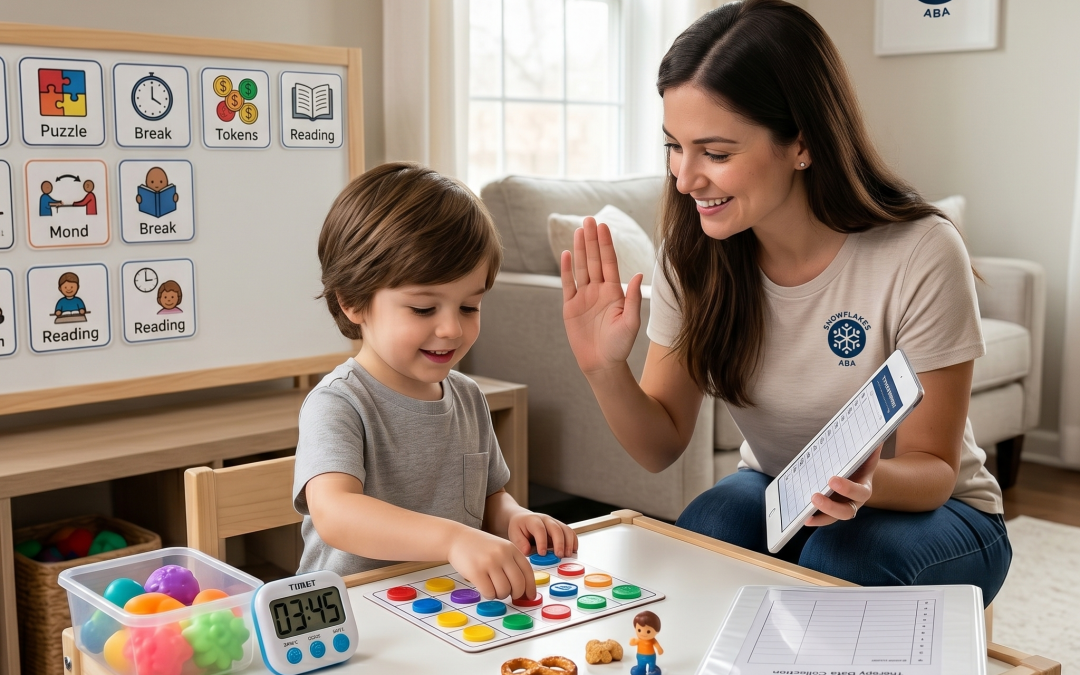
As a parent, you want the very best for your child. When you notice your child developing differently from other kids their age, it’s natural to feel worried and unsure where to turn. Many parents wondering if ABA therapy for children is the right step come to us at Snowflakes ABA with one question: ‘How do I know if my child needs ABA therapy?‘
This is one of the most important questions a parent can ask, and we’re here to help you find clarity.
What Is ABA Therapy?
Applied Behavior Analysis (ABA) is a scientifically proven therapy that helps children with autism and other developmental disabilities learn essential life skills. Specifically, it focuses on building communication, social skills, self-help skills, and reducing behaviors that may be getting in the way of learning and daily life. ABA therapy for children is backed by decades of research and is recommended by the American Academy of Pediatrics.
At Snowflakes ABA, serving families in Howard County — including Columbia, Laurel, Elkridge, and Ellicott City — we use a child-led, compassionate approach to ABA that honors each child’s unique strengths and challenges.
Signs Your Child May Benefit from ABA Therapy
Every child is different. However, here are some common signs that ABA therapy for children may be helpful:
Communication Challenges
- Your child has limited or no spoken language for their age
- They struggle to follow simple instructions
- They rarely make eye contact or respond to their name
- They repeat words or phrases without context (echolalia)
Social Difficulties
- Your child shows little interest in playing with other children
- They have difficulty understanding social cues or taking turns
- They prefer, instead, to play alone rather than with others
Behavioral Concerns
- Your child has frequent meltdowns that are difficult to manage
- They engage in repetitive behaviors like hand-flapping, rocking, or spinning
- Furthermore, they have rigid routines and become very upset when things change
- They engage in behaviors that could hurt themselves or others
Daily Living Skills
- Your child struggles with basic self-care like dressing, toileting, or eating
- They have difficulty transitioning between activities
- They need significant support to get through everyday routines
My Child Shows Some of These Signs — What Should I Do?
First, take a breath. Noticing these signs early is actually one of the best things you can do for your child. In fact, early intervention makes a significant difference in outcomes for children with autism.
Therefore, here are your next steps:
- Talk to your pediatrician. Share your concerns and ask for a developmental screening or referral to a specialist for a formal autism evaluation.
- Get a diagnosis. A formal diagnosis is typically required to access ABA services through insurance. Because of this, it is an important first step.
- Reach out to an ABA provider. Once you have a diagnosis, contact an ABA provider like Snowflakes ABA to discuss your child’s needs and begin the intake process.
You Don’t Have to Figure This Out Alone
At Snowflakes ABA, our founder is not just a Board Certified Behavior Analyst — she is also a parent of a child with autism. As a result, she has walked this road personally and built Snowflakes ABA because she wanted every family to have access to the compassionate, high-quality support she wished had been available to her.
Moreover, we work with families across Columbia, MD, Howard County, and the greater Baltimore and Richmond metropolitan areas to provide individualized ABA therapy that truly fits your child and your family.
If you’re wondering whether ABA therapy for children might be right for your child, we’d love to talk. Reach out to us today for a free consultation.
📞 443-766-9422 📧 info@snowflakesaba.com 🌐 www.snowflakesaba.com
Every child has a unique path. Let us help yours thrive.